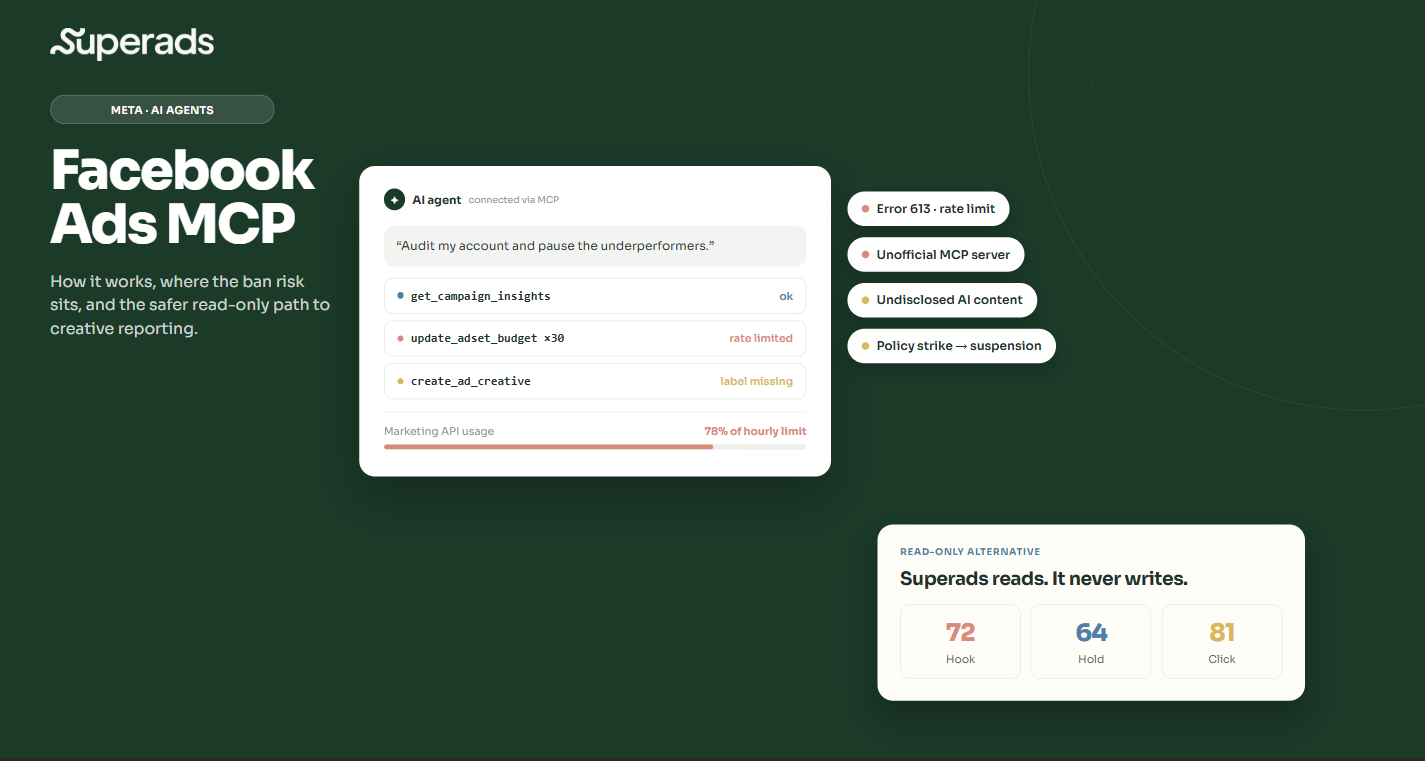
The Facebook Ads MCP (Model Context Protocol) is the new bridge between AI assistants like Claude or ChatGPT and the Meta Marketing API. It lets marketers ask questions about their ads in natural language and, in most implementations, also lets AI agents make changes to campaigns, budgets and creatives. That power comes with a real cost: rate-limit violations, undisclosed AI content and unofficial MCP servers are all active ban vectors today. This article breaks down what the Facebook Ads MCP is, how to connect to it, what benefits it delivers, where the ban risks sit, and why a read-only creative analytics platform like Superads is a safer path when your main goal is understanding ad performance.
In April 2026, Meta officially opened the door to AI agents. With the launch of the Meta Ads AI Connectors, any Claude, ChatGPT or Cursor user can now connect to their Facebook and Instagram ad accounts through the Model Context Protocol and start querying campaigns, moving budgets and spinning up new creatives in a conversation. For the first time, "ask an AI to run my Meta ads" is not a workaround. It is a supported workflow.
The reason marketers are paying attention is obvious. Paid social has become impossible to manage manually. Meta's Andromeda algorithm is making delivery decisions at a speed no human buyer can match, creative volume is the new performance lever, and reporting requests from stakeholders arrive faster than analysts can pull them. An AI that can read your ad account and write to it looks, at first glance, like the answer to every one of those problems.
But the Facebook Ads MCP is not the low-risk, plug-and-play solution the launch tweets suggest. Third-party, non-approved MCP servers have been getting ad accounts banned since 2025. Even the official Meta MCP doesn’t exempt you from rate-limit flags, the AI Content Label rule that took effect in March 2026, or standard ad-policy enforcement. And for the two most common jobs marketers actually want AI for, reporting and creative analysis, MCP is more surface area than the job requires.
This blog post covers what a Facebook Ads MCP is, how to connect to one, what it does well, where the ban risks sit and how a read-only creative analytics platform like Superads fits alongside (or instead of) an MCP setup depending on what you are trying to solve.
What is the Facebook Ads MCP?
MCP stands for Model Context Protocol. It is an open standard released by Anthropic that lets AI assistants talk to external tools and data sources through a shared interface. Instead of building a custom integration for every AI client, a service exposes an MCP server, and any MCP-compatible client (Claude, ChatGPT, Cursor, Perplexity and others) can call it.
The Facebook Ads MCP is that pattern applied to the Meta Marketing API. It wraps the endpoints behind Facebook Ads, Instagram Ads and Meta Business Suite as a set of tools an AI agent can call. Ask "how did my UGC ads perform last week?" in Claude, and the agent hits the MCP server, pulls the numbers, and answers in plain English. Ask "pause the three worst-performing ads in this campaign," and, if the MCP has write access, it does that too.
Meta launched its own hosted MCP server, Meta Ads AI Connectors, in April 2026. It lives at mcp.facebook.com/ads, uses Meta Business OAuth (no Developer App approval, no manual token juggling), and covers around 29 tools across reads and writes: campaign queries, budget updates, ad creation, audience management and performance analysis.
Third-party MCP servers exist too, most of them built on the Marketing API and hosted either locally or by an independent vendor. In July 2026, the Meta Ads MCP was made available for these developers.
Both paths point at the same underlying API. The differences are in auth, tooling coverage and, as we will see, ban risk.
How to connect Facebook Ads to an AI agent via MCP
There are three common connection paths today, ranked from safest to riskiest.
Option 1: Meta's official Ads AI Connectors
The recommended path if you want raw AI control over your Meta ads. Setup is roughly a ten-minute exercise: from a supported MCP client (Claude Desktop, ChatGPT, Cursor), point the client at mcp.facebook.com/ads, complete the Meta Business OAuth flow, and select the ad account you want to connect.
Meta's official documentation walks through the client-specific steps. The connector is free during the public beta.
Option 2: Build your own on the Meta Marketing API
For engineering teams that need custom workflows or logic the official MCP does not expose. This route requires a Meta Developer App, goes through the usual 3-day-plus review, and hands you full control over rate limiting, error handling and behavior patterns. It also hands you full ownership of ongoing maintenance.
Option 3: Third-party MCP servers
Community-built MCP wrappers, some hosted, some self-hosted. Coverage varies, some claim 130-plus tools; auth patterns vary too. The best-known open source ones live on GitHub. This is the path that generated the most ban reports, and we'll cover why in the risk section below.
Whichever path you pick, the mechanical steps are similar: pick an MCP client, complete an OAuth flow (or paste a token), and start prompting.
What you can do with a Facebook Ads MCP
For marketers, the appeal is speed. The workflows that used to require an analyst pulling reports, or a media buyer flipping between Ads Manager tabs, collapse into a conversation:
- Reporting and analysis. Ask Claude to summarize last week's spend by campaign, compare CPA across ad sets, or spot the ads that lost more than 30% of their CTR in the last seven days. The AI reads directly from your account and answers in plain English.
- Campaign changes. With write access enabled, the agent can pause underperformers, reallocate budget, duplicate winning ad sets, or roll out new creative variations.
- Cross-tool workflows. Because MCP is a protocol, an AI agent can chain the Facebook Ads MCP with other tools. Pull performance data from Meta, cross-reference it with a Google Sheet or a CRM, and generate a Slack digest.
- Bulk operations. For agencies managing dozens of accounts, MCP makes it possible to script status checks or standardized audits across the entire portfolio.
The benefit ceiling is real. Media buyers using MCP report shaving hours off weekly reporting, and creative strategists get faster answers to the "what's working right now?" questions that used to live in spreadsheets.
This is aligned with what the industry is calling AI ad optimization: AI as the operating system on top of paid social, not just an assistant next to it.
The risks of using a Facebook Ads MCP (and how accounts get banned)
The bigger the surface area you hand to an AI, the more ways it can misfire. Meta enforces the Marketing API strictly, and there are four specific vectors where MCP-connected accounts get restricted or banned.
Risk 1: Rate-limit violations
The Meta Marketing API rate-limiting rules are stricter than most operators expect. Standard-tier apps have 9,000 points per app and a 60-second block on excess, plus a per-account Business Use Case (BUC) formula of roughly 100,000 points per hour plus 40 points per active ad. Write operations cap at 100 POST calls per second.
AI agents are especially prone to tripping these limits. An assistant told to "audit my account and fix underperformers" will happily hammer the API with individual calls per ad set, per creative, per audience.
Multiple operator reports during the Meta MCP public beta flagged accounts after AI clients ran tight loops: 30 or more budget changes per hour, bulk audience updates within minutes, or repeated catalog changes with no obvious business logic. Sustained rate-limit violations, the well-known Meta 613 error, is the single most common reason accounts get flagged.
Meta detection is pattern-based, not just identity-based. Using the official MCP does not authorize every pattern of use. It just means the identity behind the call is legitimate.
Risk 2: Third-party MCP servers with unclear provenance
Last year, community-built Meta MCP wrappers were the most-mentioned cause of Meta ad account bans. The pattern: an operator configures a third-party server that authenticates against Meta's API in a non-Meta-blessed way, the server routes calls through a shared developer app and any downstream flag on that app propagates to every account using it.
Eric Carlson, a paid media operator who covered the issue publicly on X in early 2026, described it bluntly: "I have heard of a ton of instances where someone set up a Meta MCP with Facebook and got banned. Even my AM confirmed this happening." His account is consistent with what agencies and DTC operators reported across paid-media communities that year.
If you are still running an unofficial Meta MCP from GitHub or an npm package, the safer move now is to switch it off and either move to Meta's official MCP or a managed provider that goes through the sanctioned Marketing API.
Risk 3: Undisclosed AI content
Effective March 2026, Meta requires advertisers to disclose AI-generated or AI-modified content in their creatives using Meta's AI Content Label. AI-generated visual subjects, AI-modified faces or scenes, and AI-written ad copy from a large language model are all covered.
Meta is yet to confirm, but some paid performance specialists online account that undisclosed AI content accounts for roughly 14% of all ad rejections on Meta today.
An MCP that pushes AI-generated ads at scale without wiring the label into the create call is a compliance accident waiting to happen. The official Meta MCP does not exempt you here. The rule applies to every advertiser regardless of how the API is being called.
Risk 4: Standard ad-policy violations at scale
Everything that was bannable before an MCP is still bannable with one: Health and supplement claims that violate FDA standards, before/after photos that imply unrealistic outcomes, financial promises, misleading offers. Meta ad standards don’t change because an AI is behind the creative call. If anything, AI-generated copy at scale multiplies the surface for accidental violations.
The through-line across all four risks: the Facebook Ads MCP shifts a lot of ad-management authority to an AI agent, and Meta's enforcement systems do not care whether the pattern came from a human or from a model. Fast, aggressive or non-compliant actions get flagged regardless.
When the Facebook Ads MCP is worth it (and when it is not)
The MCP path fits some workflows well. Solo operators running modest spend, engineering teams building custom automations, and agencies with tight compliance guardrails can all get value out of Meta's official connector. It’s genuinely the fastest way to give a Claude or ChatGPT session direct hands-on access to your account.
But for the two most common jobs marketers actually want AI for, "understand what's working in my creative" and "give me faster, sharper reports for my team", the MCP is overkill and the ban risk is real. Reporting and creative analytics do not need write access. They need reliable reads, clean data, and a model that understands what a Hook Score or a Hold Score means in context.
That is where a purpose-built creative analytics platform sits.
How Superads reads your Meta ad data safely
Superads is an AI-powered creative analytics platform built for performance marketers, creative strategists and media buyers on Meta, TikTok, LinkedIn and Google Ads (in beta). It connects to your ad accounts through the official platform OAuth flows, syncs data through the sanctioned APIs, and then does the thing marketers actually want: it turns raw performance data into creative-level insight.
The key architectural difference from an MCP-first approach: Superads is a reporting platform, not a campaign controller. It does not push edits into your ad account. It does not attempt bulk mutations under the hood. It reads your data on a paced, compliant schedule (within 24 hours of new data being available in the native platform, with 12 months of historical backfill on the Pro plan) and gives you a place to analyze it.
That distinction matters for three reasons.
- Lower ban risk by design. Because Superads is not routing hundreds of write operations through your account, the rate-limit and abusive-pattern risks that come with agentic MCP use largely disappear. Superads goes through the official Marketing API on read-only workloads, with the pacing rules Meta expects.
- No AI Content Label exposure at the platform layer. Superads does not generate or push ads, so the AI Content Label compliance question sits with your creative process, not with your analytics tool.
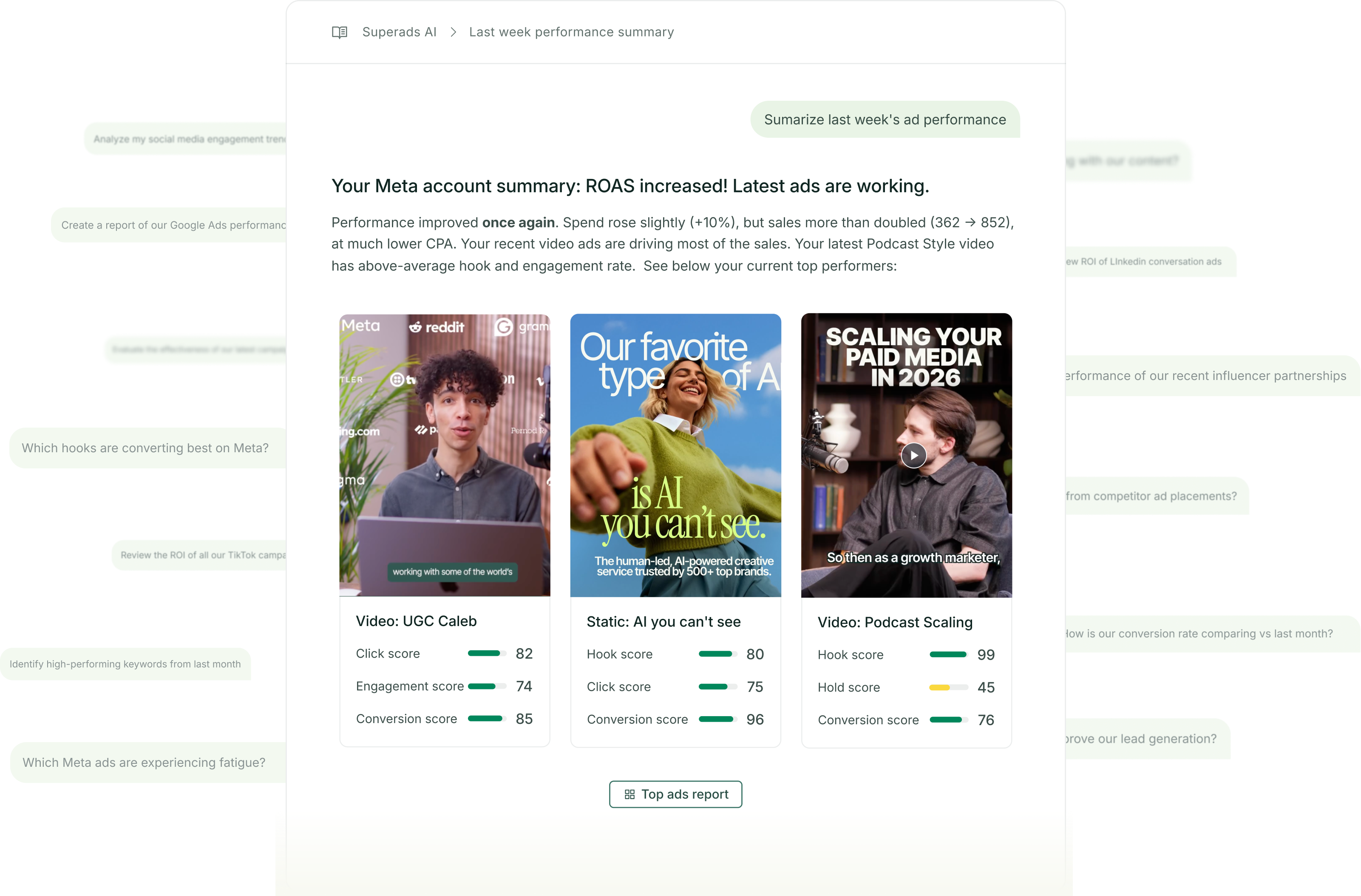
- Creative-first analysis, not raw API dumps. Superads Scores are a percentile-based creative signal calibrated against your own account. A Hook Score of 60 means the ad outperforms 60% of your other ads on that dimension. The five Scores — Hook, Hold, Click, Engagement, Conversion — turn a spreadsheet of metrics into a read on what your creative is actually doing.

Reports will be suggested to the user automatically, trends or performance patterns will be flagged and much more. Arriving at answers about what's working and what's not should be easier.

Layered on top of the Scores are AI tagging, which automatically classifies your creatives by hook type, format, visual style and content creator, and Superads AI (Ask AI), a conversational layer for asking questions about any open report in natural language.
That is the "MCP experience" most marketers actually want: natural language questions against their ad data, without exposing the account to agentic writes.
What you get with Superads vs. a Facebook Ads MCP
The two tools serve overlapping but distinct jobs. A short comparison:
- Facebook Ads MCP (official): Best for solo operators or engineers who need read + write control from an AI client. Free during Meta's public beta. Manual rate-limit and compliance monitoring. Meta only.
- Superads: Best for marketing teams that want fast, shareable creative reporting across Meta, TikTok, LinkedIn and Google Ads (beta). Read-only architecture. AI tagging and Scores built in. Ask AI for conversational analysis. Free plan available; Pro plan starts at accessible pricing for teams running real spend.
If your workflow is "pause and reallocate at machine speed," the official MCP is a fit, with the compliance layer you now know you need to wire in.
If your workflow is "understand which hooks, creators and formats are actually driving performance and share the read with my team," Superads is the shorter, safer path.
What to do this week
If you are experimenting with a Facebook Ads MCP, take the steps that reduce ban risk most:
Move off any unofficial third-party MCP servers and either use Meta's official Ads AI Connectors or a compliant managed platform. Add pacing rules to any batched operations (cap consecutive mutations at 5, watch the X-Business-Use-Case-Usage response header, back off at 75%). Wire the AI Content Label into any push step that touches AI-generated creative.
If your main goal is creative reporting rather than agentic control, connect your Meta ad account to Superads and start with the Starter Board. You get 30 days of historical data on the free plan, Scores on your first ad and a shareable report you can hand to the rest of your team without touching your write permissions.
The Facebook Ads MCP is a powerful primitive. It is also a fast way to get an ad account restricted if you treat it as a set-and-forget automation layer. A read-only, creative-first analytics platform sits comfortably beside it: use MCP for the actions you'd let a trusted media buyer take, and use Superads for the reads and creative insight your team is going to look at every day.
FAQs

Improve your clients' ROI
Track multiple accounts in just one place.
Tailored for your agency's needs. Optimize with AI.

Improve your ad campaigns
With the only AI-powered creative insights tool
built for modern marketers.