An AI platform for ad creative insights is what sits between your ad accounts and your creative decisions. It reads your live performance data from Meta, TikTok, LinkedIn and Google Ads, uses AI to tag and classify every creative element (hook, format, angle, creator) and turns that into fast answers on what's working and what to build next. This article covers what to look for in a creative insights platform, why it is safer than plugging an MCP straight into Claude, and ranks the five tools serious paid media teams use today.
Ad platform dashboards give you numbers. What they do not give you is a straight answer to the question every performance marketer asks: which creative is driving this result, and what should I build next?
That is the job an AI platform for ad creative insights is built for. Instead of asking a media buyer to spend two hours a week piecing together spreadsheets from multiple ad management tools, these platforms sync your data in one place, use AI to tag ads by hook, angle, format and creator, turning the analysis into something a whole team can read in minutes.
The category is crowded. Some tools are creative-analytics-first (built for reading performance). Others started as ad-inspiration libraries and bolted analytics on. A few come from adjacent categories entirely: user-acquisition analytics, briefing tools, competitor research.
And this year there is a new option in the mix that only exists because of Meta's official Facebook Ads MCP launch.
This article walks through what makes an AI creative insights platform useful and why a purpose-built platform is a safer setup than a raw MCP connection. Then it ranks the five tools paid media teams are seriously evaluating right now.
What is an AI platform for ad creative insights?
An AI platform for ad creative insights is a purpose-built tool that connects to your ad accounts, uses AI to classify every creative asset by its content (not just its metadata), and surfaces performance patterns at the creative element level.
The category exists because native ad platform dashboards report at the campaign or ad-set level, which is a floor too high to answer creative-specific questions.
At the baseline, these platforms do four things:
- Connect to your ad platforms (Meta, TikTok, LinkedIn, Google Ads, and in some cases mobile UA networks) and pull performance data at the ad level.
- Tag or group creatives by attributes that matter to creative decision-making — hook type, format, angle, content creator, visual style — using AI models that analyze the actual visual and textual content of the ad rather than relying on naming conventions.
- Surface patterns by showing which creative attributes drive which outcomes, ideally in a view that spans platforms and accounts.
- Let you share that view with stakeholders — creative teams, leadership, clients — without requiring them to log in to the underlying ad platform.
Where the tools differ is how deeply they go on each step, how many platforms they cover, and how they price the access. The five ranked in this article all execute the core job at a professional level. The differentiation is in workflow fit.
What makes a great AI platform for ad creative insights
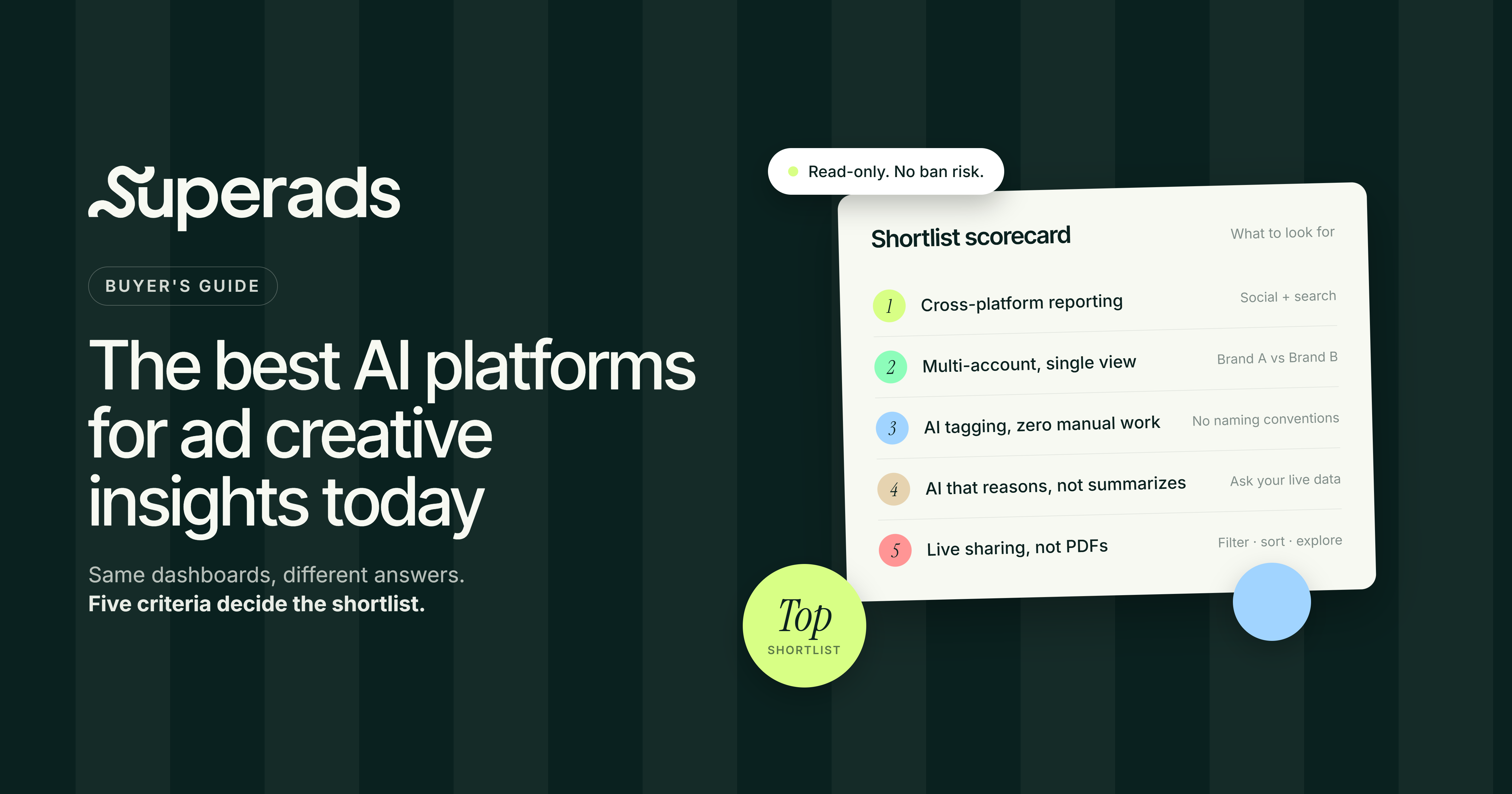
Before ranking the tools, it helps to name what separates a strong platform from a forgettable one. Five criteria matter more than the rest.
- Cross-platform reporting in a single view. If you run on Meta and TikTok and LinkedIn, comparing creative performance across them in separate reports defeats the point. The same hook can win on one platform and flop on another, and you need to see that side by side. Google Ads support (including Performance Max) rounds out the picture for teams running search alongside social.
- Multi-account reporting. Critical for agencies and any in-house team running regional or brand-specific accounts. If a tool makes you build one report per ad account, your reporting time scales linearly with your account count — a hard ceiling that arrives fast.
- AI tagging without manual work. Naming conventions are useful but incomplete. They capture what your team encodes in an ad name, not what the creative actually contains. AI tagging that classifies ads by visual style, hook type, format and content creator is the only setup that scales past 30–50 active variants without becoming unmanageable.
- A conversational layer that reasons, not just summarizes. The best platforms include an "ask your data" interface that answers questions like "which hooks are driving the lowest CPA this month?" or "which ads are showing early signs of fatigue?" in plain English, grounded in your actual account data. Static dashboards are a starting point. Conversational analysis is where the category is going.
- Live, interactive sharing. Static PDFs and screenshot exports are dead the moment they land. Live links that recipients can sort, filter and explore keep stakeholders aligned without a new reporting cycle every week.
If a tool hits three of these five, it is a real contender. If it hits five, it is worth adopting as your primary creative insights platform.
AI creative insights platform vs. Facebook Ads MCP
Since Meta's official Facebook Ads MCP launched in April 2026, a new question has landed on every paid media team's desk: should we just plug Claude or ChatGPT directly into our Meta account and ask it questions?
The MCP path is fast to set up. It is also more surface area than most creative insights workflows need, and it carries real risk that a read-only analytics platform does not.
The core difference is what the AI is allowed to do with your account. An MCP gives an AI agent both read and write access — it can pull data, but it can also change budgets, pause ads, launch campaigns and update audiences.
When the agent runs tight loops (30+ budget changes per hour, bulk audience updates, repeated catalog changes), Meta's automated risk systems can flag the account. Operator reports during the MCP's public beta surfaced rate-limit warnings, temporary suspensions and, in extreme cases, full account restrictions.
That is on top of the AI Content Label requirement Meta has enforced since March 2026, where undisclosed AI-generated ads are the third-largest ad rejection category on the platform.
An AI platform for creative insights is architecturally different. It reads your data through the official APIs on a paced, compliant schedule, and it does not push writes back to your account.
There is no rate-limit risk from agentic loops, no ban vector from AI-generated ads pushed without the disclosure label and no need to monitor an autonomous agent's actions in real time.
What you give up is direct campaign control from the AI conversation. What you gain is a system that will not put your ad account on a policy review because a Claude session got aggressive.
The practical answer for most teams is that these two categories are complementary, not competing. Use the Facebook Ads MCP for the actions you would trust a media buyer to run — pausing underperformers, reallocating budget — with pacing rules wired in.
Use an AI platform for creative insights for the daily analysis, reporting and creative decisions that make up 90% of the work. The article on Facebook Ads MCP risks and safer setups covers the compliance layer in detail.
The 5 best AI platforms for ad creative insights
Below is a fair, side-by-side look at the five platforms serious paid media teams are shortlisting today. Each entry covers what the tool does best, where it has gaps, who it fits and what it costs — plus, for each of the other four, where Superads differentiates.
1. Superads — Best overall for cross-platform AI creative insights
Superads is the only creative analytics platform that includes both LinkedIn and Google Ads alongside Meta and TikTok in a single report. That platform coverage is the reason most cross-channel paid media teams end up here, but the depth goes further than just channel support.
Superads was built by a team of data engineers, math PhDs and AI specialists who took on the performance analytics challenge as the primary product from day one, not as an add-on to a briefing or inspiration tool.
- At the core of the product is Superads Scores: a 0-to-100 percentile ranking across five dimensions (Hook, Hold, Click, Engagement, Conversion) calibrated against your own historical data rather than a generic global benchmark. A Hook Score of 78 means the ad outperforms 78% of your other ads on that dimension.
- Layered on top are AI tagging (automatic classification by hook type, visual style, format, content creator, language, and custom criteria — no naming conventions required), Superads AI (a conversational assistant that reasons through your live data with zero hallucination), and Workflows (scheduled AI reports delivered to Slack or email).
- Sharing is another structural advantage. Every report and Board is a live, interactive URL. Recipients can adjust date ranges, apply filters and explore data themselves — no static PDFs, no snapshot exports, no per-seat costs. For agencies managing multiple brands, multi-account reporting is included on every plan, including the free tier.
Notable customers: 5,000+ teams including Roogenic, Oneflow, MOOD Innovations, and hundreds of agencies. The platform is used across DTC, SaaS, B2B and creative agencies running from a single ad account up to enterprise multi-brand setups.
Pros:
- Only tool with Meta + TikTok + LinkedIn + Google Ads (beta) in a single report
- AI tagging with no naming convention setup required
- Superads AI reasons through live data, not just summarizes it
- Multi-account reporting on every plan (free included)
- Live, interactive shared reports with unlimited users, no per-seat pricing
- Free forever plan; Pro starts at $49/month with no contracts
Cons:
- Ad inspiration library and competitor research features are on the roadmap, not yet in-product
- Third-party attribution integrations (GA4, Northbeam, Triple Whale) are coming soon, not yet live
- Google Ads support is in beta
Pricing: Free plan (permanent, one report, Scores, unlimited users and ad accounts, 30 days of data). Pro from $49/month, scaling with ad spend. All pricing is public on the Superads pricing page.
Superads makes our analytics crystal clear and helps us effectively create and measure content. Our ROAS has definitely improved.
We needed creative performance data that the design team could actually open and explore — not a PDF that landed in someone's inbox already out of date.
2. Motion — Strongest visual reporting for single-brand DTC

(Source: Motion)
Motion is the most established creative analytics tool in the category and the reference point most teams compare other platforms to. Its strength is polished, visual reporting designed for single-brand DTC ecommerce teams that need clean stakeholder-facing outputs.
The Inspo tool for competitor research and inspiration is a genuinely useful add-on, particularly for creative strategists building swipe files ahead of production.
Where Motion falls short is at the multi-brand and cross-channel edges. Reports are scoped to one ad account, which means agencies managing more than one brand build one report per client — a workflow that gets expensive fast.
Channel coverage stops at Meta, TikTok, LinkedIn and YouTube. Google Ads search and Performance Max are not supported, which is a hard limit for teams running search alongside social. Sharing is structured around snapshots and guest accounts rather than fully interactive shared links, and higher-tier pricing is not publicly listed.
Notable customers: HexClad, Ridge, MUD/WTR, Simple Modern and other DTC-heavy brands. Motion is particularly common in the higher end of the DTC ecommerce segment.
Pros:
- Clean, visual report layouts optimized for creative team review
- Inspo tool for competitor ad inspiration is a genuine strength
- Creative Scores for surfacing high-performing patterns
- GA4 and Northbeam attribution integrations on Pro+ plans
Cons:
- Single-account per report; multi-brand agencies build one report per client
- No Google Ads search or Performance Max support
- Sharing is snapshot-based, not fully interactive
- $250/month entry point; higher tiers require a sales call
- No permanent free tier — 14-day trial only
Pricing: 14-day trial, no free plan. Starter at $250/month (analytics + AI, capped at $50K/month in ad spend). Pro, Growth and Agency tiers require a demo.
For single-brand DTC teams, Motion's visual reporting is solid. For agencies and any team running cross-channel campaigns, Superads pulls ahead on four structural fronts — read the full breakdown here.
3. MagicBrief — Visual reports with creative briefing built in
 (Source: MagicBrief)
MagicBrief sits between an analytics tool and a creative production suite. Its analytics surface creative element analysis (hooks, messaging, emotion, CTAs), but the platform's bigger strength is upstream: a 12M+ ad inspiration library, modular briefing tools, storyboards, script generation and structured briefs.
If your team's workflow is heavily focused on researching, briefing and producing ads (with analytics as a secondary layer), MagicBrief covers more of the creative process end-to-end than any other tool on this list.
The channel coverage skips Google Ads entirely. And the price of admission — $249/month with a 3-month initial commitment — is a real barrier for teams that just want to evaluate a tool before betting on it.
Notable customers: Rothy's, Perfect Snacks and other DTC brands with high creative production volume, plus multiple creative agencies.
Pros:
- Strong ad inspiration library with AI-powered search (12M+ ads)
- Modular briefing tools — storyboards, scripts, structured briefs
- AI tagging for themes in the library
- Useful for teams that want briefing and analytics in one tool
Cons:
- No Google Ads support
- Multi-account reporting is restricted to paid plans
- 7-day trial only, no permanent free tier
- $249/month entry price with a 3-month initial commitment
- Analytics depth has stagnated relative to specialist analytics platforms
Pricing: No free tier. Starts at $249/month, 3-month initial commitment. Higher tiers require a sales conversation.
MagicBrief is genuinely strong on the briefing side. Superads is genuinely stronger on the analytics side — full comparison here.
4. Foreplay — Best for ad inspiration and swipe-file workflows
 (Source: Foreplay)
Foreplay was early to the ad discovery and inspiration space and built one of the largest ad libraries available — 100M+ ads with AI-powered search.
Its core product is Discovery (the ad library) and Spyder (competitor monitoring), plus modular briefing tools like storyboards and script generation. More recently, Foreplay added Lens, an analytics product that extends the platform into performance data.
If your primary need is inspiration, swipe files and competitor research, Foreplay is purpose-built for that job and it shows. The library is the deepest in the category, and Spyder's competitor tracking is a genuine strength for creative strategists documenting what other brands run over time.
Where Foreplay falls short is on the analytics side, which is newer and shallower than tools where analytics is the primary investment. Multi-account reporting is capped (one Meta ad account on the $175/month Workflow plan, ten accounts on the $459/month Agency plan). And Lens is not included in the base Foreplay tier.
Notable customers: Rothy's, Bombas, Warby Parker and other high-volume creative operators, plus creative agencies focused on paid social production.
Pros:
- The largest ad inspiration library on the list (100M+ ads)
- Spyder for competitor monitoring is a strong creative strategy tool
- Strong modular briefing tools (storyboards, scripts, structured briefs)
- Lens analytics surfaces creative element insights and benchmarks
Cons:
- Lens analytics is Meta-only (no TikTok, LinkedIn, or Google Ads)
- No multi-account reporting in a unified view
- Account caps: 1 on Workflow, 10 on Agency, no way past ten
- 7-day trial only, no permanent free plan
- Lens starts at $175/month on top of any other Foreplay plan
Pricing: 7-day trial. Workflow at $175/month (1 Meta ad account, 5 users, Lens included). Agency at $459/month (10 ad accounts, 10 users, white-label share pages).
How Superads differentiates: Foreplay wins on inspiration and briefing. Superads wins on analytics depth and cross-channel coverage — see the full comparison.
5. Segwise — Best for mobile gaming and cross-network UA teams
 (Source: Segwise)
Segwise is the most specialized platform on this list. It is built primarily for mobile game studios, subscription apps and DTC brands running cross-network user acquisition campaigns.
Uniquely, it supports 15+ ad networks including the gaming-specific ones (Unity, AppLovin, Mintegral) that no other tool in this list covers. The multimodal AI analyzes video frames, audio, on-screen text and image components together — including playable ads, which most analytics tools cannot tag.
The trade-off is fit. Segwise is built for UA managers and performance marketers working in mobile environments, not for creative teams or DTC brands running standard paid social.
The interface and feature set assume technical fluency, and the insights get generic on smaller accounts (the platform is optimized for $20K+/month in spend). Competitor tracking is Meta-only. And pricing is not fully public — serious tiers require a demo.
Notable customers: Mobile gaming studios (typically less publicly documented than DTC brands) and subscription app teams. Segwise's differentiator in this segment is the MMP (mobile measurement partner) integration, which ties creative performance to install, retention and LTV metrics that matter for gaming and app UA.
Pros:
- Cross-network coverage including mobile gaming networks (Unity, AppLovin, Mintegral)
- Multimodal AI analyzes video, audio, on-screen text and playables
- MMP integration ties creative to install, retention and LTV
- Automatic creative fatigue detection across networks
Cons:
- Built for UA managers, not creative teams; steep learning curve for non-technical users
- Insights can feel generic on accounts spending less than $20K/month
- Competitor tracking is Meta-only
- Pricing requires a demo for serious tiers
Pricing: 14-day free trial. Paid plans scale with creative volume and networks; pricing is not fully public on the website.
How Superads differentiates: These two tools serve different customers. For mobile gaming studios and cross-network UA teams that need MMP integration and playable-ad tagging, Segwise is the specialist. For everyone else — DTC brands, B2B SaaS, agencies, in-house teams running paid social — Superads is a stronger fit.
Comparison table: 5 AI platforms for ad creative insights at a glance
| Platform | Best for | Channels | AI creative tagging | Entry price |
|---|---|---|---|---|
| Superads | Cross-platform paid media teams, agencies | Meta, TikTok, LinkedIn, Google Ads (beta) | ✅ Automatic, no naming needed | $49/month |
| Motion | Single-brand DTC ecommerce | Meta, TikTok, LinkedIn, YouTube | ✅ Yes | $250/month |
| MagicBrief | Teams wanting briefing + analytics in one | Meta, TikTok, YouTube, LinkedIn | ⚠️ Library-focused | $249/month (3-month commit) |
| Foreplay | Ad inspiration and swipe-file workflows | Meta (Lens analytics); Meta + TikTok + LinkedIn (research) | ⚠️ Lens is newer | $175/month for Lens |
| Segwise | Mobile gaming and cross-network UA | 15+ networks incl. Unity, AppLovin, Mintegral | ✅ Multimodal incl. playables | Demo required |
Why Superads is the strongest fit for AI-driven creative insights
Every tool on this list solves a real problem for the audience it was built for. Motion is polished for single-brand DTC teams that want visual reports. MagicBrief is a bundled workflow platform for teams that need briefing and analytics under one roof. Foreplay is the ad-inspiration reference tool with analytics layered on. Segwise is the specialist for mobile gaming UA.
Superads is different because it was built for the exact problem the keyword describes — AI-powered creative insights, not creative production, not competitor research, not user acquisition analytics. Every part of the product maps back to that one job.
- Cross-channel coverage that actually matches how paid media teams run. Meta, TikTok, LinkedIn and Google Ads (beta) in a single report is unique on this list. No other tool covers all four. For B2B and SaaS teams that need LinkedIn alongside paid social, or for teams running Performance Max alongside Meta, this is the difference between one dashboard and four.
- AI tagging that works from day one. Superads AI automatically classifies every ad by hook type, visual style, format, content creator and emotional trigger — no naming conventions required, no manual tagging, no setup week before you can extract value. If you do use naming conventions, Superads makes the most of them by scanning your structure, auto-suggesting groups and extracting values with a few clicks.
- Superads AI is built for reasoning, not summaries. Ask "which hooks are driving the lowest CPA this month?" or "which creators are producing the strongest engagement across my TikTok campaigns?" and get specific, data-backed answers in seconds, grounded in your actual account data. Not templated dashboards. Not pre-built reports. Real conversational analysis.
- Sharing that respects how teams actually work. Every Board and report is a live, interactive URL. Recipients can filter, sort and explore on their own. Clients get their own view without a seat license. Design teams can open a link and immediately see which of their concepts are winning. No PDFs. No snapshots. No "let me email you the updated version."
- Pricing that respects the evaluation. Free forever plan with Superads Scores, custom breakdowns, unlimited users and unlimited ad accounts on the free tier. Pro starts at $49/month — the lowest entry price on this list, roughly 5x lower than Motion or MagicBrief. No sales call. No 3-month commitment. Cancel anytime.
Creative is the single most important factor in digital marketing success. Marketers can't afford to waste time guessing — they need fast, accurate signals on what's working.

The teams that get the most out of an AI platform for ad creative insights are the ones who pick a tool that fits their actual stack rather than the one with the loudest positioning. For most modern paid media teams — cross-channel, multi-brand or agency, mixed DTC and B2B — that tool is Superads.
Ready to connect an ad account and see your first Board? Get started with Superads for free.
Already using Motion, MagicBrief or Foreplay? Request a free migration — the Superads team will help you get set up.
FAQs about AI platforms for ad creative insights

Improve your clients' ROI
Track multiple accounts in just one place.
Tailored for your agency's needs. Optimize with AI.

Improve your ad campaigns
With the only AI-powered creative insights tool
built for modern marketers.