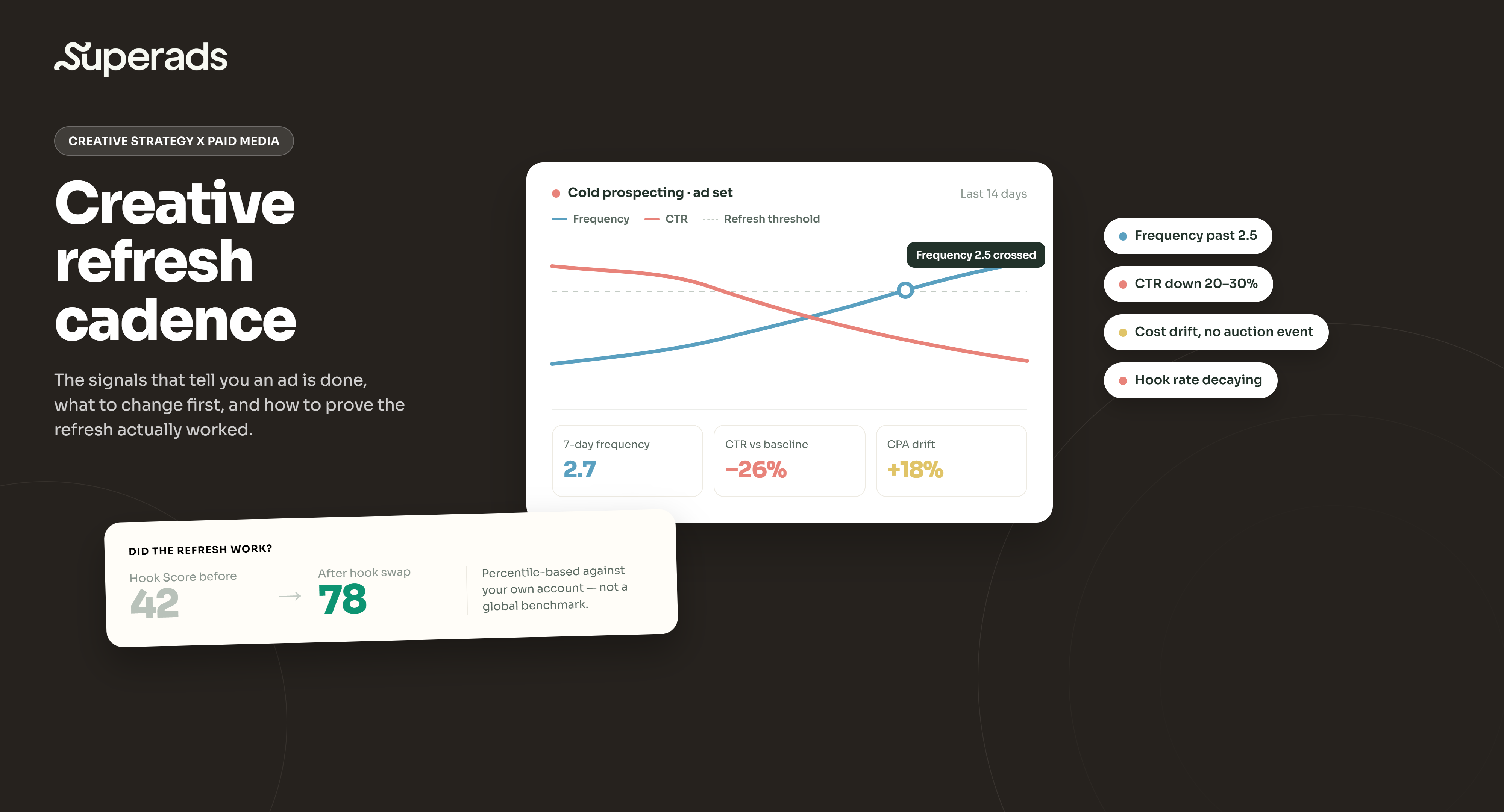
Ad fatigue kills performance when audiences see the same creative too many times. Spot it early by watching CTR drops, CPC spikes and frequency creep. Different platforms might fatigue at different speeds (TikTok faster than Meta), so refresh strategically: swap hooks first, test systematically and let your data tell you when. Superads shows you exactly which ads and creative elements are fatiguing across all your campaigns, so you can fix problems before they wreck your budget.
Your best-performing ad just died overnight.
CTR tanked. CPA doubled. And you're burning your budget while your audience has tuned out. Welcome to creative fatigue: the silent campaign killer that drains ROI faster than any targeting mistake ever could.
Creative fatigue happens when people see the same ad elements so many times they stop paying attention. Unlike landing pages issues or seasonal dips, fatigue is entirely preventable. You just need to catch it early and refresh strategically, not randomly.
The catch? Most marketers don't spot creative fatigue until it has already wrecked their numbers. They're stuck with slow dashboards that make patterns impossible to see, or they're refreshing creatives based on gut feel instead of data. By the time they realize what's happening, they've already sacrificed ROI..
This guide shows you how to identify creative fatigue before it kills performance, which metrics actually matter and how to build a refresh strategy that works across Meta, TikTok and LinkedIn.
Plus, we'll show you how Meta's new Creative Fatigue tracker fits into your monitoring stack (spoiler: it's not enough on its own) and how Superads can help.
What is creative fatigue? (and why it goes beyond a single ad)
Creative fatigue, also called ad fatigue, is what happens when your audience sees the same creative elements (hooks, visuals, messaging, CTAs) so many times that they stop engaging.
It's not that they hate your brand. They're just bored of seeing the same thing.
The important thing to understand is that fatigue isn't just about one ad running too long. It can spread across your entire account if multiple ads share similar hooks, visuals or messaging. Even if no single ad has high frequency, your audience can still tune out when everything looks and sounds the same.
The numbers tell the brutal truth. Research from Simulmedia shows that seeing an ad for the first time makes viewers 5.7% more likely to purchase than not seeing it at all.
But people who saw the ad 6-10 times were 4.1% less likely to buy than those who saw it 2-5 times. It gets worse. People who saw the ad 11+ times were 4.2% less likely to buy than those who saw it 6-10 times.
And even your best performers aren't safe. Confect.io found that top-performing ads lose 38% of their effectiveness after just five weeks of running unchanged. For average campaigns, this drop reaches 53% by week eight.
How fatigue looks different across platforms

Fatigue doesn't hit every platform the same way. On Meta (Facebook and Instagram), you'll notice a gradual decline in click-through rates (CTR) and higher CPAs creeping in over weeks. On TikTok, fatigue strikes fast.
Engagement metrics can die overnight because users expect constant freshness and scroll past anything that feels repetitive.
Understanding these platform differences is critical for knowing when to update your creatives.
Why creative fatigue kills performance
When creative elements fatigue, three things happen fast and they compound on each other to destroy your campaign economics.
- Engagement drops. People scroll past without clicking because they've mentally filed your ad under "already seen." This isn't a small dip. You can see CTR fall 30-50% or more once fatigue sets in. Your audience has learned to ignore you and that's nearly impossible to reverse without fresh creative.
- Platform algorithms notice. Meta, TikTok and LinkedIn all deprioritize ads with declining engagement. When your CTR drops, the algorithms interpret that as a signal that your ad isn't relevant. They respond by showing it to fewer people and charging you more per impression. This means fewer impressions and higher CPMs, which doubles down on your performance problems.
- Costs spike. You're paying more to reach fewer people and the people you do reach aren't converting like they used to. Your CPC climbs because the platform is working harder to find anyone who'll click. Your CPA skyrockets because even the clicks you get are from less-qualified audiences who are less likely to convert.
The result? Your ROAS craters, your CPA shoots up and suddenly that winning creative isn't winning anymore. What worked last month is now actively losing you money.
Here's the catch: declining performance isn't always fatigue. It could reflect deeper issues like poor audience targeting or stale messaging. Pinpointing the cause helps avoid costly missteps (more on this later).
How to spot creative fatigue: the metrics that actually matter
Most marketers wait too long to refresh because they're watching the wrong signals. Here's what to monitor and when to act.
1. Click-Through Rate (CTR) decline
When CTR drops 20-30% from your baseline, ad fatigue is setting in. This is your earliest and most reliable signal. Don't wait for it to crater. Act when you see consistent decline over 3-5 days (TikTok) or 1-2 weeks (Meta).
CTR decline is the canary in the coal mine. It tells you people are scrolling past before engagement or conversion metrics even have a chance to suffer. By the time your conversion rate tanks, you've already burned budget on impressions that went nowhere.
2. Cost Per Click (CPC) increase
Rising CPC means platforms are working harder to get the same clicks. If your CPC climbs 30%+ without changes to targeting or budget, refresh your creatives.
This happens because the algorithm recognizes your ad is underperforming and has to show it more times (or to less ideal audiences) to generate clicks. You're essentially paying a fatigue tax. The longer you wait, the more expensive it gets.
3. Frequency Creep
Frequency measures how many times the average person sees your ad. On Meta:
- Frequency of 3-4 is healthy for most campaigns
- 5-7 is the warning zone (monitor closely)
- 8+ means you're oversaturating your audience
On TikTok, frequency moves faster. Anything above 2-3 in a short timeframe deserves attention.
Frequency is an average. If your campaign shows a frequency of 5, some people have seen your ad 10+ times while others have only seen it once. That means fatigue is already hitting part of your audience even when your average frequency looks acceptable.
4. ROAS erosion
When ROAS drops consistently over several days without external changes (seasonality, promotions, competitive shifts), it's usually ad fatigue. Your ad isn't converting like it used to because people are tuning out.
Watch for gradual decline rather than sudden drops. Sudden ROAS changes usually point to targeting issues, budget shifts or market conditions. Gradual erosion over 5-10 days with stable frequency? That's fatigue creeping in.
Meta's new creative fatigue tracker

Meta recently rolled out a Creative Fatigue tracker in the Account Insights tab for select advertisers. According to Meta, it flags when your cost per result is 2x or more compared to past performance, which gives you a high-level heads-up through their opportunity score system.
Here's how it works: Meta tracks all recent exposures of your ad's image or video (including those from other campaigns from your Page) and compares your current cost per result against historical performance.
When your cost per result climbs higher than past ads but less than 2x as much, you'll see a "Creative Limited" status. When it hits 2x or more, you'll see "Creative Fatigue" in the delivery column.
Meta will even warn you before you publish if they predict creative fatigue may occur in the first 7 days of your campaign.
However, to stay ahead of ad fatigue, you need creative-level analytics that show you which specific hooks, formats or messaging themes are wearing out before the algorithms punish you for it. You need to see patterns across all your campaigns, not just get alerts when individual ad sets hit crisis mode.
That means tracking performance at the creative element level, comparing how different hooks or visual styles perform over time and catching decline at 20-30% drops in CTR, not waiting for 2x cost increases.
Meta's tracker is useful for confirming what you suspect. But it's not enough to catch fatigue early enough to protect your budget.
How to beat creative ad fatigue with proven strategies
Beating ad fatigue isn't about randomly swapping creatives every week. It's about building a system that keeps your campaigns fresh without blowing up your production budget or losing what actually works. Here's the framework that top-performing teams use.
Step 1: Match your refresh timing to platform dynamics
Ad fatigue doesn't hit at the same speed across platforms. Each channel has its own pace and you need to adapt your refresh strategy accordingly.
TikTok: 3-7 Days

TikTok's own guidance recommends refreshing creatives when "delivery results exhibit a consistently declining trend." In practice, this happens fast. Research shows that TikTok's Smart Creative feature automatically pauses videos showing signs of fatigue within the first 3-5 days.
Why so fast? TikTok's endless scroll format and algorithm-driven content velocity mean users encounter your ads more frequently in compressed windows. The platform rewards novelty and freshness above almost everything else. TikTok data shows that campaigns with 10+ unique creatives in North America achieve 1.3x higher ad recall and 3x higher purchase intent compared to campaigns with fewer than 5 creatives.
Plan to test new hooks and visual variations weekly at minimum. For high-budget campaigns pushing significant daily spend, you may need to refresh every 3-4 days.
Meta (Facebook and Instagram): 1-2 Weeks
Meta recommends uploading new creatives "a few times per month" to maintain stable delivery at scale. Industry data shows that campaigns with frequency below 2.5 maintain stable performance, while those above 3.0 show measurable drops in CTR and conversion rates within 3-5 days.
Smaller audiences (under 100K) burn through creative faster. When frequency hits 2.0 in small audiences, you're already seeing performance drops. Medium audiences (100K-500K) give you more breathing room and can sustain the same creative until frequency approaches 2.5. Large audiences (500K+) can run creatives longer, but you still need to watch for CTR decline as your primary warning signal.
LinkedIn: 2-4 Weeks
LinkedIn ad fatigue builds slower than Meta or TikTok because of the platform's professional context and more defined audience pools. Best practices suggest refreshing creatives every 1-2 weeks for optimal ad relevance scores, though many successful campaigns run 2-4 weeks before showing fatigue symptoms.
The key difference is frequency expectations. For LinkedIn retargeting campaigns, average frequency typically ranges from 5-10 impressions per user over 90 days. That's significantly lower than Meta, where you might hit frequency of 5-7 in a single week.
Step 2: Build a systematic creative testing framework
Random refreshes waste budget and make it impossible to learn what actually works. Test systematically instead.
Start with Hooks
Your hook (the first 2-3 seconds of video or your opening headline) fatigues faster than any other creative element.
Hooks "demand regular refreshes to stay compelling" because they're what audiences see first and most frequently.
If your CTR is dropping but your video completion rate stays stable, your hook is the problem. People are scrolling past before they even give your ad a chance.
Test 3-4 new hooks against your creative control. Keep everything else identical so you can isolate what's working.
Winning hook structures to test:
- Pattern interrupts (unexpected visuals or statements)
- Direct questions that create curiosity gaps
- Bold claims that challenge assumptions
- Problem statements your audience immediately recognizes
- Benefit-driven openings that promise specific outcomes
Promote the winning hook and retire underperformers. Track performance weekly and swap in fresh hooks when CTR drops 20% from baseline.
Then Test Visuals
After hooks, update your imagery, video style or graphic treatments. This is where you maintain your core messaging but refresh the execution. Research on creative component fatigue shows that visuals need "periodic tweaks to fuel engagement" but fatigue slower than hooks.
Test different visual approaches:
- UGC-style videos vs. polished brand content
- Product close-ups vs. lifestyle contexts
- Static images vs. motion graphics or video
- Different color palettes or design treatments
- Testimonial formats vs. product demonstrations
Keep your value proposition and messaging consistent. You're refreshing how you present your message, not changing what you're saying.
Step 3: Use modular creative systems for fast iteration
Think of your ads like building blocks instead of monolithic units. Build component libraries you can mix and match without starting from scratch each time.
Hook Library: 10-15 Tested Variations
Maintain a rotating library of proven hooks. Document which hooks work for different campaign objectives (awareness vs. conversion) and audience segments (cold vs. warm). When you need to refresh, pull from your library instead of brainstorming from zero.
Visual Style Bank: 3-5 Distinct Formats
Stock your arsenal with different visual approaches:
- Product-focused (clean shots, demos, features)
- Lifestyle (product in use, aspirational contexts)
- UGC-style (creator content, testimonials, raw footage)
- Educational (how-tos, explainers, tutorials)
- Emotional (storytelling, problem-solving journeys)
Test performance across formats and rotate based on what's wearing out.
Messaging Angle Rotation: 3-5 Value Props
Most products have multiple benefits. Cycle through different value propositions to keep messaging fresh:
- Speed/efficiency
- Quality/results
- Price/value
- Ease of use
- Status/identity
When one angle fatigues, pivot to another. This approach lets you maintain brand consistency while keeping ads from feeling repetitive.
Step 4: Prioritize high-impact changes over surface tweaks
Not all creative updates deliver the same performance lift. Focus your effort where it actually matters.
High-Impact Changes (Start Here)
Opening hooks (first 2-3 seconds or headline) drive the biggest performance swings. A great hook can revive a fatiguing campaign overnight. Poor hooks kill even brilliant creative.
Visual style shifts (UGC vs. polished, static vs. video, light vs. dark) create enough novelty to reset audience attention without requiring complete creative rebuilds.
Core value propositions or messaging angles give you entirely new ways to position your product. When one benefit stops resonating, rotate to another.
Medium-Impact Changes (Test After High-Impact)
B-roll footage or secondary visuals refresh the feel of your ad without changing its core structure. Useful for extending the life of winning concepts.
Music or voiceover style changes the emotional tone. Can make stale creative feel fresh again, especially in video ads.
Ad copy variations (different phrasing, tone shifts, emphasis changes) help when your visuals still work but your message needs updating.
Low-Impact Changes (Only Fix If Broken)
CTA button text ("Shop Now" vs. "Buy Now") rarely moves the needle unless your existing CTA is actively confusing people.
Minor color adjustments or background elements create the illusion of freshness without meaningfully changing performance.
Font or typography tweaks fall into the same category. Only test these after you've exhausted high and medium-impact changes.
Start with high-impact when you're fighting fatigue. Save low-impact for optimization after you've re-established performance baseline.
Step 5: Segment and rotate audiences to reduce oversaturation
Sometimes your creative isn't the problem. You're just hitting the same people too often.
Exclude Recent Converters
If someone bought in the last 30 days, they don't need to see your acquisition ads immediately. Exclude them and reallocate that budget to fresh prospects. This prevents frequency buildup on audiences who've already converted.
Exception: retargeting campaigns for repeat purchases or upsells. Those audiences should see different creative focused on complementary products or loyalty messaging.
Segment by Engagement Level
Create separate ad sets for people who've engaged with your ads (clicked, watched, commented) vs. cold audiences who haven't interacted yet. Show different creative to each group based on their familiarity with your brand.
Warm audiences know who you are. They can handle more direct conversion messaging. Cold audiences need awareness-focused creative that builds interest first.
Use Frequency Caps Where Available

Meta doesn't offer frequency caps in all campaign types, but use them when possible (Reach campaigns, some awareness objectives). Optimal frequency typically falls between 1.01-2.99 for most campaigns.
On LinkedIn, set frequency caps to avoid oversaturating small B2B audiences. For a 90-day campaign, aim for 5-10 unique impressions per user and match your creative quantity to that frequency target.
Google Display and programmatic platforms also support frequency capping. Set limits based on campaign objective and expected conversion windows.
Step 6: Implement dynamic creative to automate variation

Dynamic creative formats automatically rotate headlines, images and CTAs within the same ad unit. It's your best defense against ad fatigue on Meta and TikTok because it ensures audiences see different executions over time without manual intervention.
How It Works
Upload 5-10 variations of each creative element (images, headlines, descriptions, CTAs). The platform's algorithm tests combinations in real-time and serves the best-performing versions to each audience segment. Audiences see different creative executions across impressions, which reduces fatigue while the algorithm optimizes for performance.
Meta's Advantage+ Creative and TikTok's Automated Creative Optimization both work on this principle.
Make Variations Meaningfully Different
Dynamic creative only works if your variations are actually different. Don't just swap "Buy Now" for "Shop Now." Test different hooks, value props and visual styles.
Weak variation set:
- "Get yours today"
- "Shop now"
- "Order today"
Strong variation set:
- "Join 10,000+ satisfied customers"
- "See results in 30 days or get your money back"
- "The solution you've been searching for"
The algorithm needs real differences to test against. Give it options that represent distinct positioning angles.
Step 7: Monitor performance at the creative level, not just campaign level

Here's where most marketers hit a wall. Native platform dashboards show performance by campaign or ad set, but ad fatigue happens at the creative level. You need granular visibility into which specific creative elements are declining.
What You Actually Need to See
Which hooks are losing effectiveness across multiple campaigns. Your "before/after" hook might be crushing it in one campaign but fatiguing in three others. Without creative-level visibility, you can't spot that pattern.
Which visual styles still drive engagement. Maybe UGC-style content is wearing thin while product demos maintain strong performance. You need to see that comparison across your entire account.
Which messaging angles are wearing out. If all your "save time" messaging is declining while "save money" messaging holds steady, that tells you exactly where to focus your next creative brief.
Native dashboards don't show these patterns. You're stuck manually comparing dozens of ads across campaigns, trying to piece together which elements actually matter.
That's the exact problem Superads solves. More on that in the next section.
How Superads helps you stay ahead of creative fatigue

Catching creative fatigue early means spotting patterns across all your ads before performance tanks. That's hard when your data is scattered across Meta Ads Manager, TikTok Ads, LinkedIn Campaign Manager, and a dozen spreadsheets.
Superads centralizes your creative performance data in one place, so you can see exactly which ads are declining and why, fast.
What Superads Does Differently

1. Ask Your Data Directly With Superads AI: Instead of digging through dashboards to find fatiguing ads, Superads AI lets you just ask. Type "Which ads are experiencing fatigue?" or "Which creative elements are working best?" and get instant answers from your actual account data. No manual analysis required.
3. Creative-Level Analysis, Not Just Campaign Stats: Superads breaks down performance by individual creative elements: hooks, visuals, messaging angles, and formats. You can see which specific hooks are losing steam or which visual styles still drive results, even across multiple campaigns.
3. AI-Powered Creative Grouping: Instead of relying on naming conventions (which most teams don't follow consistently), Superads uses AI to automatically group your ads by creative themes. It identifies patterns like "testimonial-style videos" or "product close-ups" and shows you which categories are fatiguing.
4. Multi-Platform View: Creative fatigue doesn't care about platform silos. An audience might see your TikTok ad, then your Meta ad, then your LinkedIn ad—all with the same hook. Superads shows cross-platform performance so you can spot oversaturation before it kills results everywhere.
5. Scores That Make Decisions Easy: Superads Scores give you an at-a-glance view of creative health. When scores start dropping, you know it's time to refresh—no guesswork required.
6. Faster Refresh Cycles When you can see exactly which creative elements are fatiguing, you can refresh strategically instead of rebuilding everything from scratch. That means lower production costs, faster turnarounds, and less wasted spend.
"Superads makes our analytics crystal clear and helps us effectively create and measure content. Our ROAS has definitely improved." — Jordan Bruno, Marketing Director at Roogenic
Roogenic used Superads to identify which messaging angles were wearing out across their campaigns.
Instead of replacing entire ads, they swapped in new hooks while keeping the rest of their creative intact.
Result? They maintained performance without blowing up their production budget.
Creative fatigue is predictable. Act before it costs you
Creative fatigue isn't a mystery. It's a predictable pattern that happens when audiences see the same thing too often. The difference between teams that stay ahead and teams that burn budget? Data.
When you can see which creative elements are declining before performance craters, you refresh strategically. You test smarter. You keep campaigns profitable longer.
Stop waiting for Meta to tell you there's a problem. Start monitoring your creative performance at the level that actually matters: the creative itself.
Try Superads free and see exactly which ads are fatiguing across all your campaigns.
FAQs

Improve your ad campaigns
With the only AI-powered creative insights tool
built for modern marketers.
Improve your clients' ROI
Track multiple accounts in just one place.
Tailored for your agency's needs. Optimize with AI.
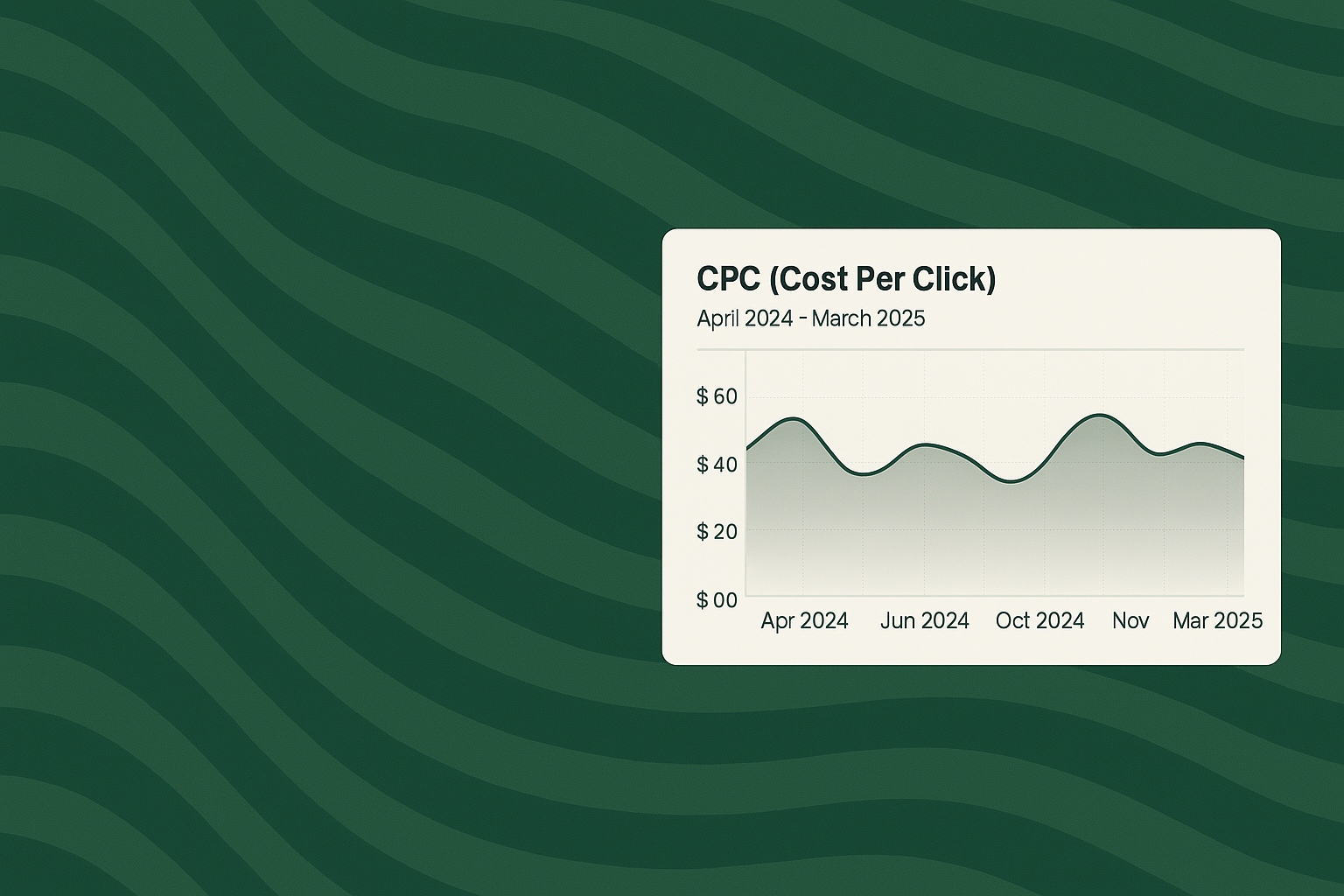
Facebook Benchmarks
Check out fresh CPC, CPM, CTR
Facebook Ads data.
Filter by industry, country or
campaign type.
Improve your ad campaigns
With the only AI-powered creative insights tool
built for modern marketers.